SOP & Letter of Motivation Builder
Write your SOP yourself — and beat AI detectors.
Your grades show what you did. Your statement of purpose is the only place you say why — in your own voice. UniPilot guides you question by question, flags clichés as you type, and scores how human your draft reads, so it stays authentically yours.
Try it now — get a first draft in under a minute
Free to use. Your statement stays private to you.
Try it now — get a first draft in under a minute
We'll draft a Statement of Purpose (SOP).
A narrative essay on how you arrived at this field and where you're going. Standard for the US, UK, Canada, Australia and most English-speaking programs. Set the destination country to switch format.
Name real facts: your degree and university, the year, and a course or project that shaped your direction. The more concrete you are, the better the draft.
Add about 80 more characters — name your degree, university, and a course or project.
Free to use. Your statement stays private to you.
One builder. The right document for where you are applying.
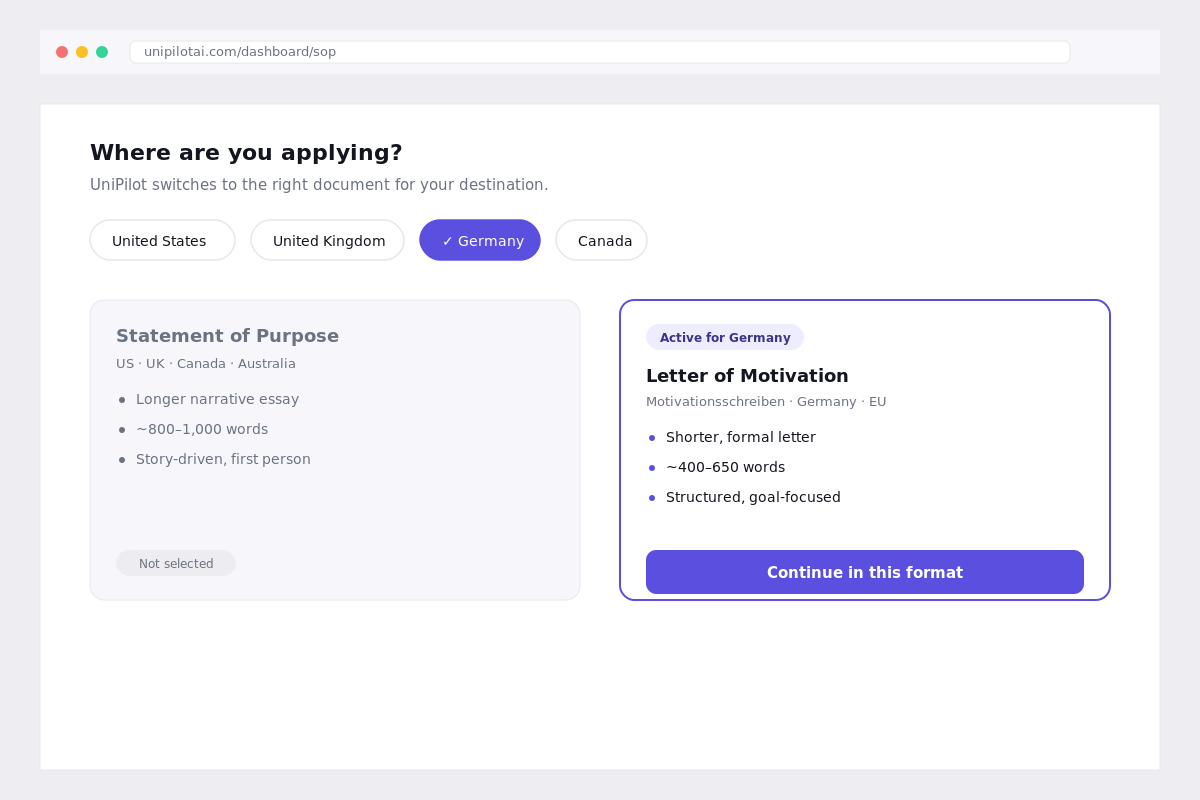
Different countries ask for different documents. The US, UK, Canada, and Australia expect a Statement of Purpose — a longer narrative essay. Germany and much of continental Europe ask for a Letter of Motivation (Motivationsschreiben) — shorter, more formal, and structured differently.
You don't have to know which is which. Set your destination country and UniPilot switches to the right format, length, and structure automatically — same guided flow, correct output.
Why letting AI write your whole SOP backfires
AI detectors are now standard
Universities run admissions essays through AI detectors. A statement flagged as machine-written can sink an otherwise strong application.
AI hands everyone the same essay
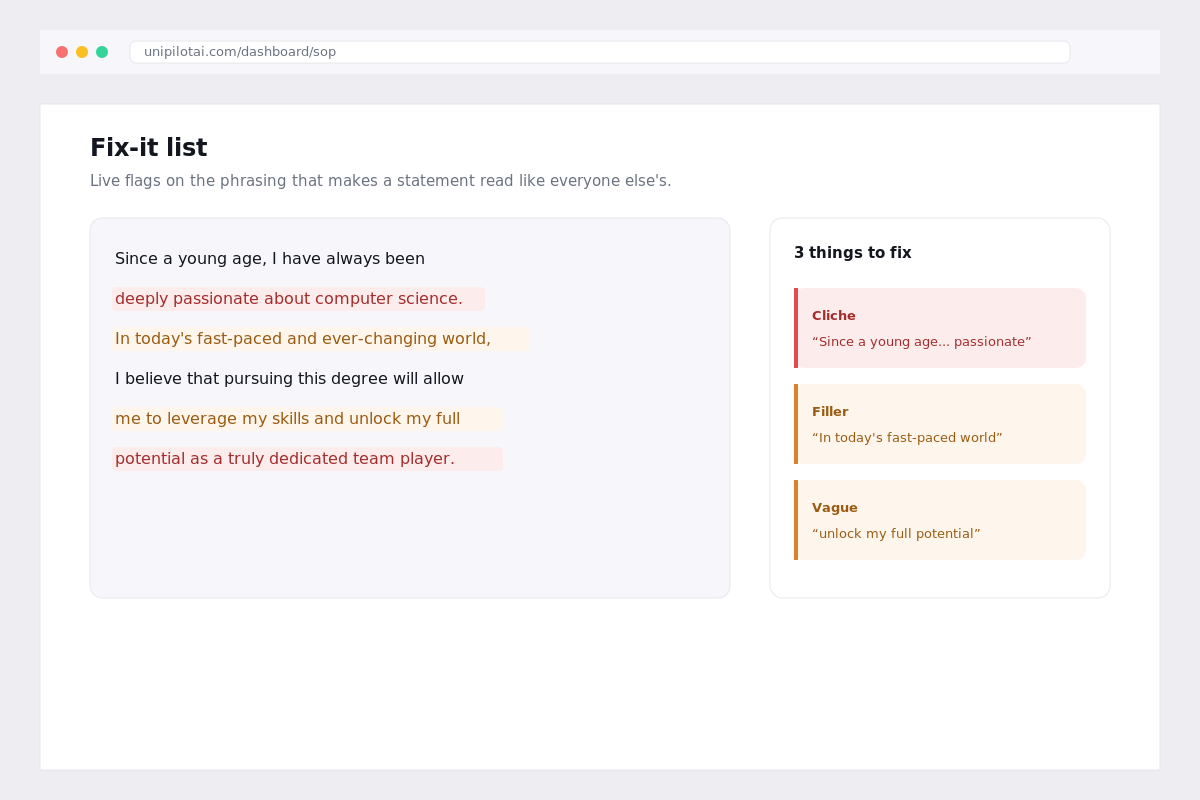
Readers see "since a young age I was passionate" hundreds of times a season. Generic AI prose blends into the rejection pile.
AI doesn't know your story
It can't know your real reasons, projects, or setbacks — so it invents generic ones that don't sound anything like you.
How UniPilot helps instead
No AI writes your statement for you. The tools below help you write a stronger one, faster — in your own words.
Guided questions
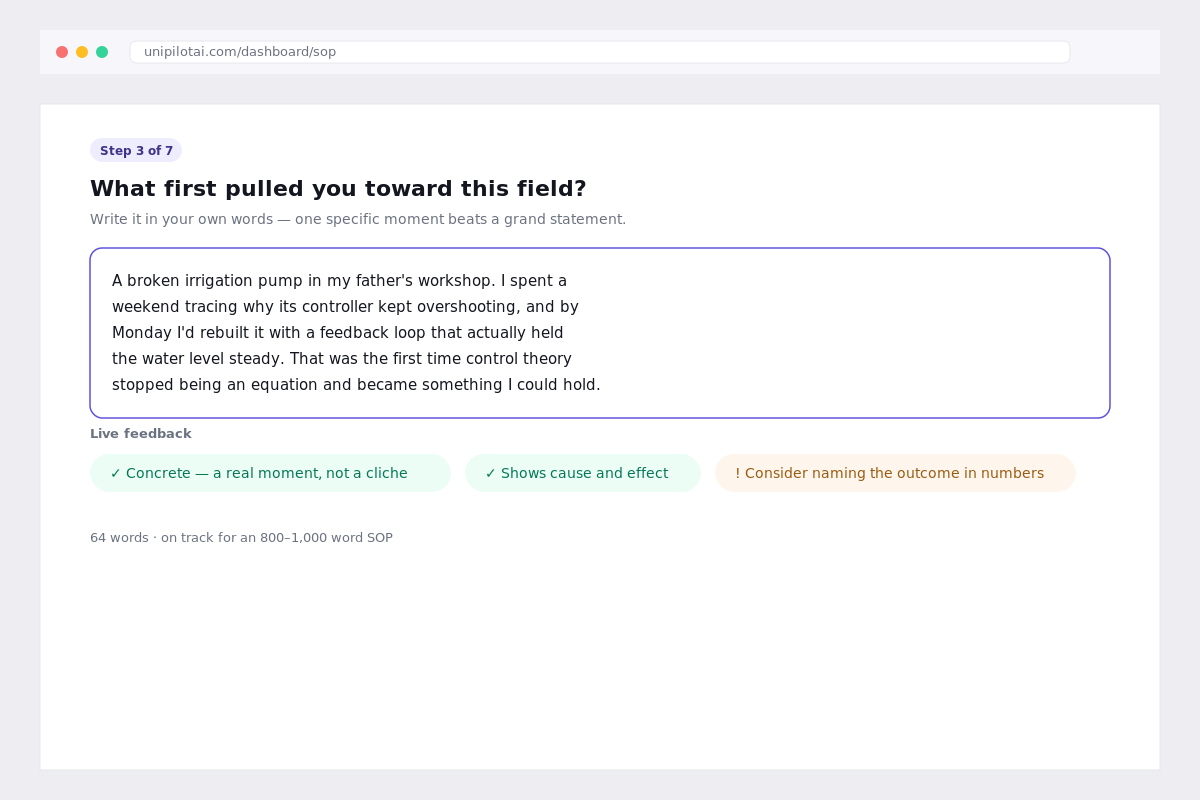
Plain-language prompts pull your real story out — in your own words. Your answers get assembled into a first draft you then make yours.
Cliché linter
Live flags on tired phrases, filler, and overused openers as you type, so every line earns its place.
Human Score
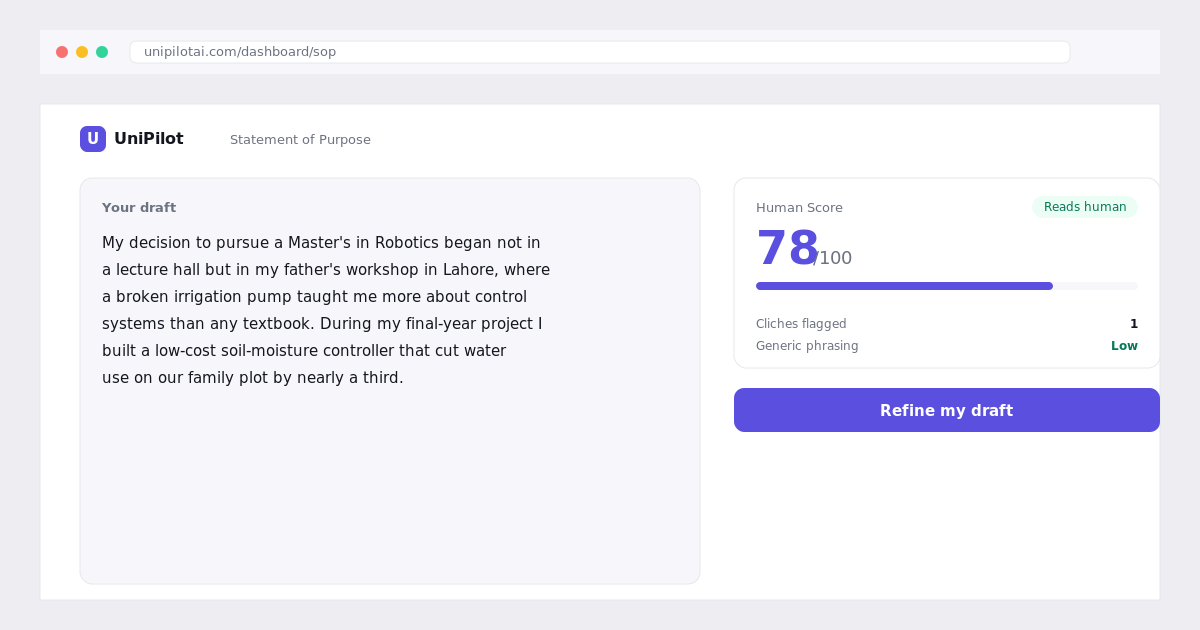
A running score of how human your draft reads, so you can tighten it before you ever hit submit.
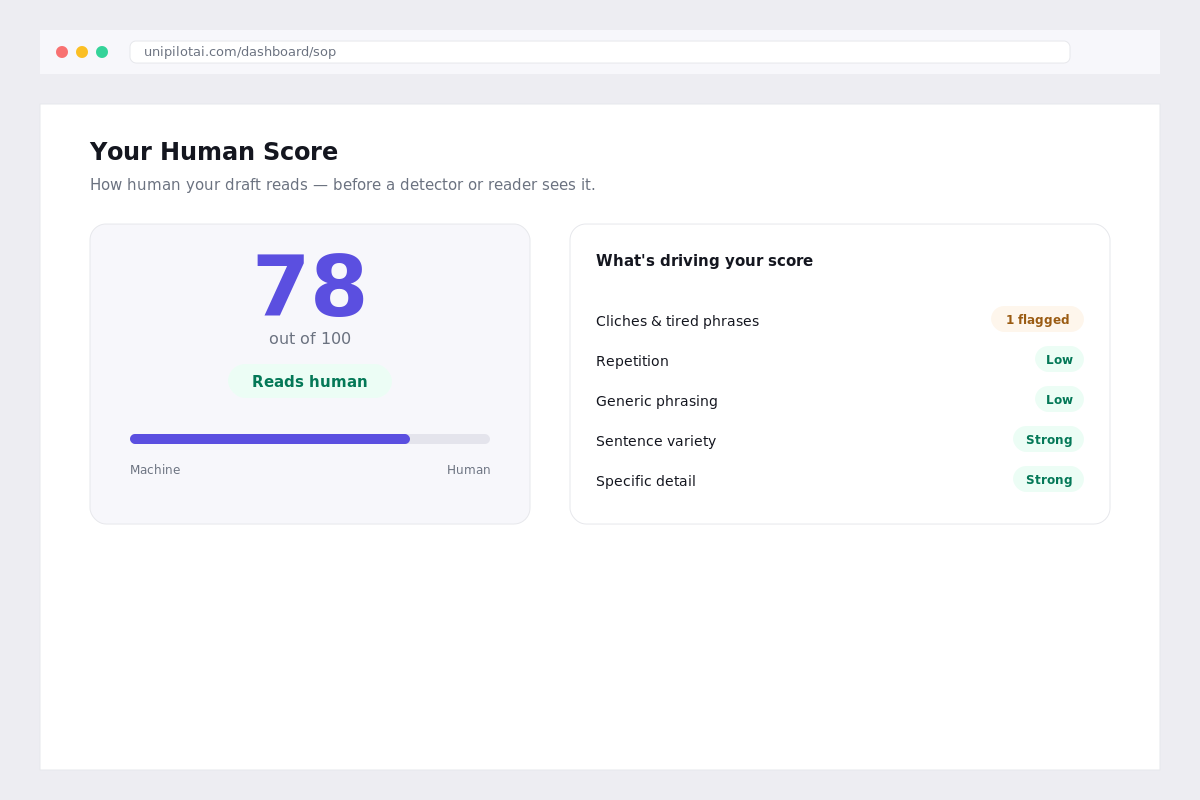
It never makes things up
The builder won't invent a university, professor, grade, or number. Where a fact is missing it leaves a clearly marked blank for you to fill — never a fabricated detail.
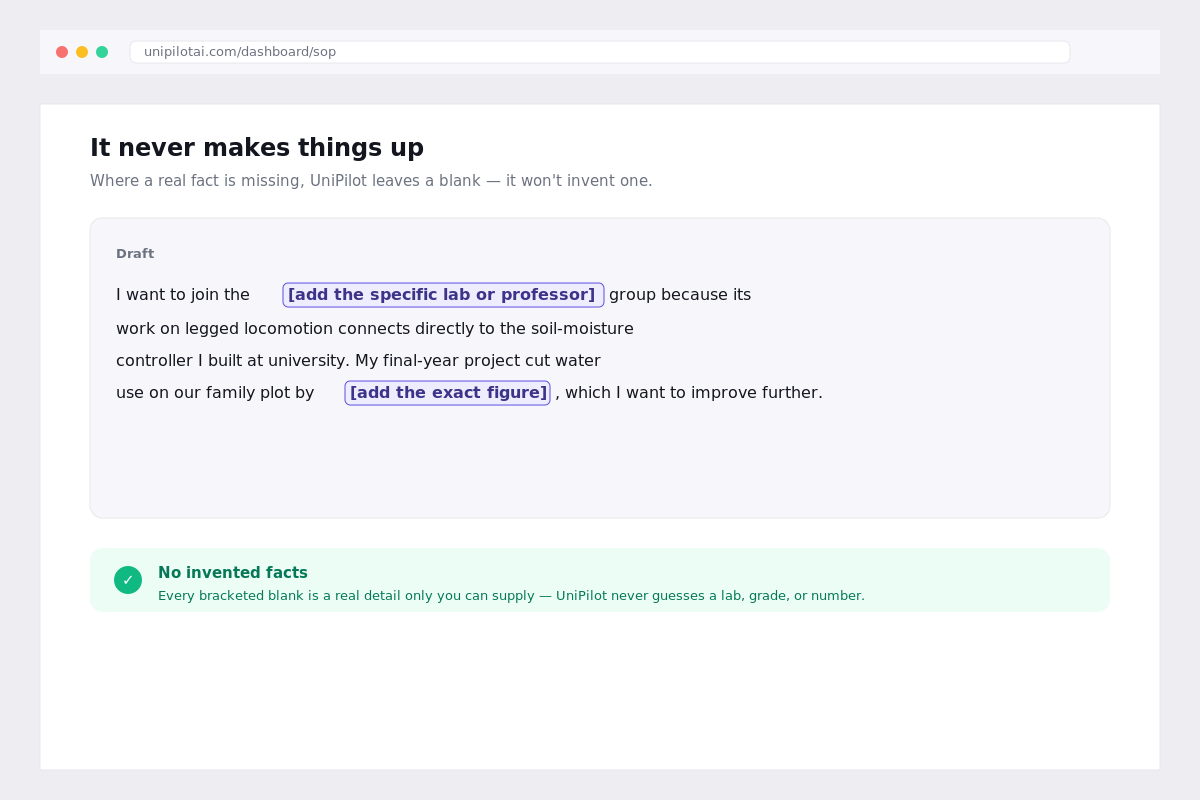
See your Human Score before admissions does
The Human Score is a running 0–100 estimate of how human your draft reads. It watches for the signals that give AI-written text away — clichés, repetition, and generic phrasing — and shows you exactly where to tighten. It's your own read on the statement before a detector or an admissions officer ever gets one.
It's a guide, not a guarantee: no local score can promise what a third-party detector will say. But a higher score means your words read as genuinely yours.
How long should an SOP or Letter of Motivation be?
A Statement of Purpose usually runs around 800–1,000 words — roughly one to two pages. A German Letter of Motivation is shorter, usually around 400–650 words on a single page. When a program states an exact limit, always follow that limit over any general guidance.
SOP vs personal statement — what is the difference?
A Statement of Purpose is focused and forward-looking: your academic goals, the specific program, and why it fits. A personal statement is broader and more reflective, leaning on personal background and motivation. Many universities use the terms loosely — read the prompt carefully and answer what it actually asks for.
Need examples? Browse our application guides.
Frequently asked questions
- Is the SOP builder free?
- Yes. Creating an account and building your statement is free. Your statement stays private to you.
- Will my statement pass AI detectors?
- The builder is designed so the final words are yours — you write and edit every line, guided by prompts and feedback rather than letting a model write for you. That's the most reliable way to stay clear of AI-detection screening. The Human Score gives you a local estimate, but no tool can guarantee a third-party detector's result.
- What is the difference between an SOP and a Letter of Motivation?
- A Statement of Purpose is the longer narrative essay expected by the US, UK, Canada, and Australia. A Letter of Motivation (Motivationsschreiben) is the shorter, more formal letter most German-speaking and several continental-European universities ask for. Set your destination country and the builder switches to the right format automatically.
- Does an AI write my SOP for me?
- Only if you ask it to as a starting point — and even then it's clearly a first draft you must rewrite in your own voice. The core builder is no-AI by design: it organises what you write, flags weak phrasing, and never invents universities, professors, grades, or numbers.
- How long should my statement be?
- An SOP is usually around 800–1,000 words (roughly one to two pages). A German Letter of Motivation is shorter — usually around 400–650 words on a single page. Always follow the specific length a program asks for when it states one.
- What is the Human Score?
- The Human Score is a 0–100 estimate of how human your draft reads, based on signals like clichés, repetition, and generic phrasing. A higher score means your statement is more likely to read as genuinely yours rather than machine-written. It's a guide for tightening your draft, not a guarantee about any external detector.